
Washington County Past-Resident Sources
Different eras require different Washington County records. Deeds identify owners, while directories and census schedules can identify listed occupants. Newspapers, probate, maps, and permits fill gaps. Start with the newest reliable parcel evidence and move backward, because an old street label alone may not point to the same land.
Previous residents become clearer when every source is dated and kept within its scope. One entry may name the taxed owner, another a listed subscriber, and another the people counted by a census taker. Agreement across independent records makes the address trail stronger.
| Source | Local time span | Custodian or shelf | Clue for past residents |
|---|---|---|---|
| Current land index | After the historical cutoff; exact start not established | Washington County Circuit Clerk | Recorded title transfers and parties |
| Chronicle land index | 1834-1991 | Washington County Archives online and originals | Grantor, grantee, book-page, and linked images |
| City and telephone directories | Individual catalog issues; statewide shelf 1840-1999 | Grace Keith Collection and Arkansas State Archives | Listed occupants or subscribers by name and sometimes address |
| Federal census | 1830-1950 public, at ten-year intervals with gaps | FPL, NARA, and FamilySearch access | Household members and residence |
| Local newspapers | Named runs from 1841 to the present, with gaps | Fayetteville Public Library | Moves, deaths, sales, and social notices |
| Fayetteville Sanborn atlas | 1930 free set; other referenced editions require verification | Library of Congress and local library | Building footprint, use, and address context |
A nineteenth-century trail soon reaches Chronicle and the original deed books. A twentieth-century Fayetteville trail gains directories, census schedules, newspaper runs, and Sanborn sheets. Recent addresses lean on DataScout, current deeds, GIS, and the correct city or county planning desk.
Access is not limited to web pages. Visit or call the Circuit Clerk for current instruments and certified copies, and use Archives for historical books and handwritten indexes. Grace Keith can answer an on-site or remote research request. The Arkansas State Archives supplies another directory and census shelf. A targeted Arkansas FOIA request can seek an existing administrative file, but it does not replace court access rules or the ordinary fee for a certified land record.
Anchor Washington County Address History
Begin with today's situs address in the Washington County DataScout search. Save the parcel number, owner name, separate tax-mail address, legal description, and subdivision or lot-block details shown. Situs means the physical location. The mailing address is where tax notices go and may belong to an owner who lives elsewhere.
The legal description is the key to continuity. Annexation, rural-route conversion, and street changes can alter the postal label while the land identity remains. Research found no official countywide renumbering chronology, so a confident address bridge must come from plats, deed calls, parcel history, maps, and dated directories.
Note: Homestead credit can support owner occupancy, but it does not prove every member of a household or rule out other residents.
Walk Washington County Deeds Backward
The deed chain supplies the owner side of previous-resident research. Open the current purchase instrument through the Circuit Clerk's land-record route. Record both parties, the date, legal description, and document or book-page reference before making the next search.
- Pull the current owner, parcel number, and legal description from the Assessor's property roll.
- Find that owner's acquisition deed in the current Circuit Clerk system and note its seller.
- Search the seller as an earlier buyer, or grantee. Confirm that the legal description still matches before accepting the link.
- Repeat until the trail reaches 1991, then move into the Archives Chronicle grantor-grantee index.
- Use Chronicle book-page references and scans. Ask Archives for the original handwritten index or deed book when transcription or image access is uncertain.
- Grantor and grantee
- The grantor transfers an interest; the grantee receives it. To move backward, search a seller as the buyer in an earlier deed.
- Chain of title
- The linked sequence of recorded transfers for the same land.
- Legal description
- The recorded land identity, such as lot and block or metes and bounds. It is more durable than a postal address.
This chain proves recorded ownership, not who slept in the home. An estate, trust, entity, or non-sale conveyance may also interrupt a simple buyer-seller pattern.
Recorded plats can repair a break when the parcel was split or combined. Compare subdivision, lot, block, acreage, and deed calls rather than matching a street number alone. For an unplatted rural tract, metes-and-bounds language may be the only stable bridge. The county Public Webmap gives spatial context but is not survey information, so a map outline cannot replace the legal description.
Bridge Washington County at 1991
The Archives Chronicle land search covers 1834 through 1991. Search controls include document type, a full-text field, book, start and end page, a grantor or grantee mode, and separate last and first names. The portal is free and may link a scanned PDF.
View the Chronicle source before running a previous residents search.
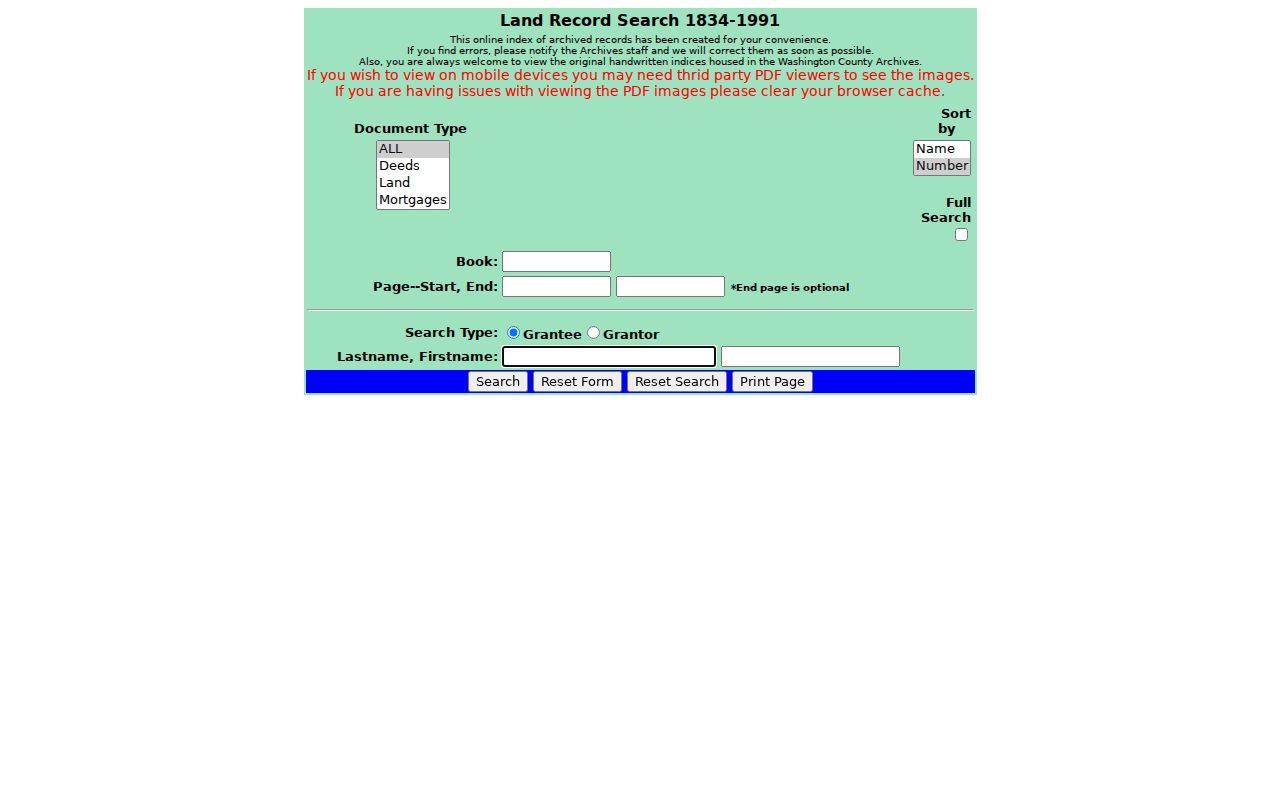
The interface marks the bridge between current indexing and nineteenth-century evidence. It is a finding aid, not a substitute for the instrument. Chronicle explicitly keeps original handwritten indexes available and invites error reports, which is unusually useful when spelling or transcription breaks a chain.
Before or within the 1834 starting point, work with Archives staff and the original books. The county was organized in 1828, while its published research chronology starts probate in 1830, land in 1834, court in 1835, and marriage in 1845. One blanket start year would be wrong.
Chronicle's fields support more than a surname search. A known deed can lead directly to book and page, while document type and full search may help with a difficult index entry. Save both the typed result and the linked image. If a phone or tablet will not display the PDF, Archives notes that a separate viewer or cleared cache may help, but staff access to the original remains the stronger fallback.
Match Washington County Households
Owners are only half the prior-resident trail. A reverse or criss-cross directory arranges entries by address, while an alphabetical entry may add a spouse, occupation, or other publisher-specific clue. A telephone book is narrower because it usually names the subscriber rather than every adult.
- Start with the known address and year. Check an address-arranged section if that edition has one.
- Copy the entry exactly, including spelling, initials, spouse, occupation, and abbreviations.
- Check the alphabetical entry and the publisher's abbreviation key. Never assume a code means the same thing in every volume.
- Move to nearby editions. A one-year omission may reflect publication timing rather than a move.
- Pair the directory with a public census schedule, newspaper, yearbook, deed, or probate record.
The 1950 census is the newest public federal decennial schedule in 2026 under the 72-year rule. The Grace Keith collection lists Arkansas census holdings from 1830 through 1940 and also provides FamilySearch affiliate access. The detailed shelf belongs on the Washington County city directory page; the goal here is to place occupants at one address.
Local newspaper coverage adds a dense timeline between census years. Fayetteville runs named by the library begin with the Witness in 1841 and continue through several Democrat and Times titles into the current regional paper. The Prairie Grove Herald covers 1903 through 1932. Look for move notices, property sales, deaths, social columns, and public notices, then confirm each claim against a deed, vital record, cemetery source, or probate file.
See 1930 Fayetteville Buildings
The Library of Congress provides a free 1930 Fayetteville Sanborn atlas with 27 sheets. A Sanborn map is building evidence. It can show a footprint, construction material or use, and the street number or label used at that time. It does not name every resident.
Find the sheet index, locate the block, and compare the building outline with a plat and present parcel. Historical sources mention Fayetteville Sanborn editions across 1895 through 1940, but only the verified 1930 online item should be treated as the free set. Ask the library about other editions rather than assuming a continuous digital run.
This comparison may explain why a household appears to vanish. The structure may have been replaced, renumbered, split, or combined while the legal parcel trail continued.
Read maps at the scale they were made for. Sanborn sheets focus on fire risk and built form, not full household identity. A structure may have a use label without a personal name. Match sheet number, block position, street label, nearby landmarks, and footprint with a dated directory and plat before deciding that an old building is the same one visible today.
Ask Washington County History Desks
The Grace Keith Genealogy Collection at Fayetteville Public Library is the main local fallback when digitization ends. Its holdings include more than 14,000 print items plus microfilm, microfiche, maps, and digital images. Staff accept remote research requests, sometimes with costs, and provide in-library tools and FamilySearch affiliate access.
Ask for an exact address, approximate year, known names, and the kind of volume sought. Request the title, publisher, issue year, and whether it contains alphabetical, address, household, or telephone-only listings. The collection is on the fourth floor at 401 W. Mountain Street in Fayetteville. The genealogy desk is 479-856-7253.
Washington County Archives adds original land indexes, deed books, a 1908 plat book, and record groups for court, tax, school, licenses, communities, cemeteries, post offices, and school districts. These channels can identify a prior resident who never appears in a modern web index.
University of Arkansas Special Collections and the Shiloh Museum of Ozark History can add photographs, manuscripts, oral histories, and organization records. Their material is context rather than a substitute for title or residence proof. The Washington County Historical Society's Flashback and local vertical files may also reveal older place names that make a stalled address recognizable.
Follow Washington County Estate Clues
When title passes through an estate, a standard sale search may stall. Search the decedent in Search ARCourts, then request the public probate petition, order, or related filing from the proper clerk. An obituary can supply kin, dates, former places, and organization ties, while the probate file explains fiduciaries or heirs connected to the land.
The Arkansas Judiciary is moving users from Public CourtConnect to Search ARCourts. Review the official migration notice before choosing the current case-search route.
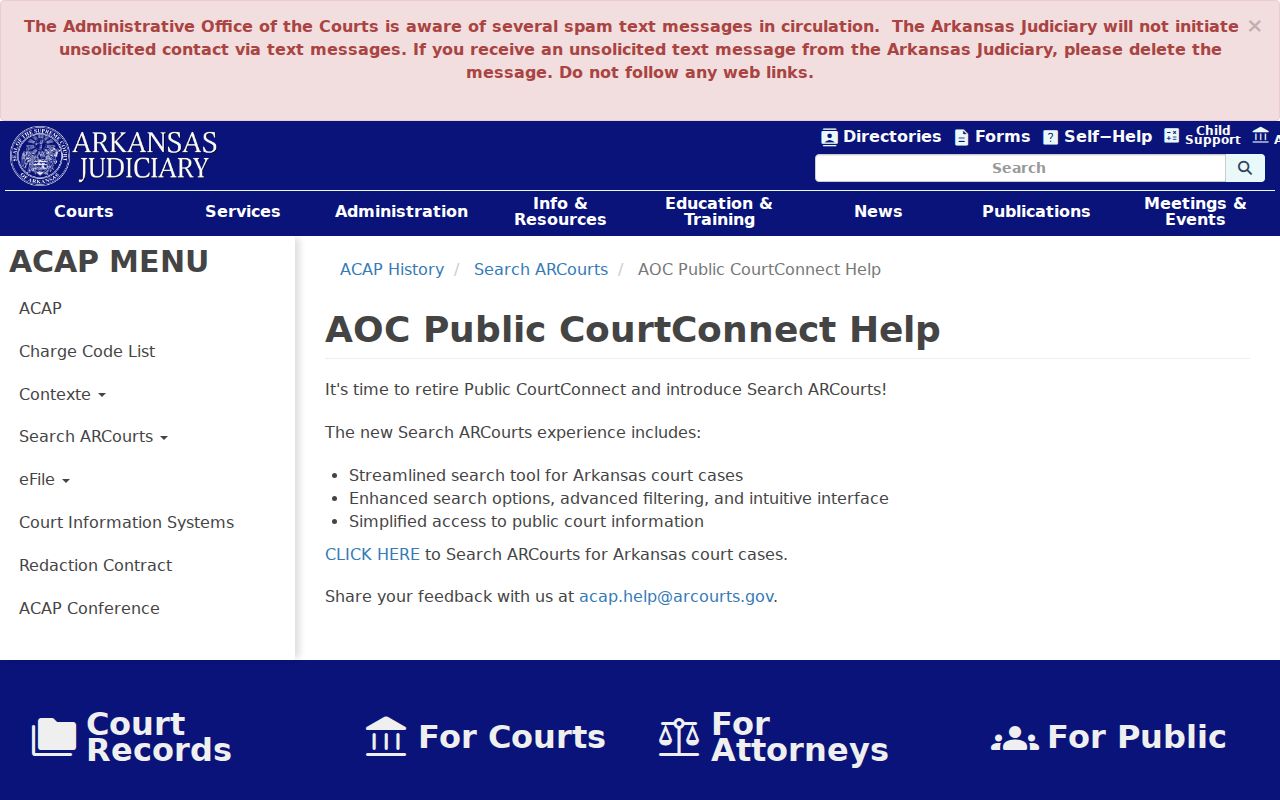
The notice dates an active system change. Search ARCourts supplies public index information; the Washington County Circuit Clerk or the appropriate clerk supplies the actual file and any certified copy. Sealed or confidential material will not appear.
Ask for a case by number when possible and name the document and date wanted. A public terminal may offer docket navigation that is less convenient online, subject to confidentiality. Court index fields such as case style, filed date, party role, event, and disposition help distinguish similar names, but a docket entry should not be read as the full order.
Judge Washington County Past Residents
A deed supports ownership. A directory supports a listed occupant or subscriber at the publication date. A census supports the enumerated household. An obituary or probate filing supports family and estate links. None should be stretched into a fact that it was not created to record.
Use at least two dated sources before deciding that similar names describe the same person. Middle initials, spouses, kin, occupation, legal description, and geography can separate repeated Ozark family names. Women may appear under maiden and married names, and deeds may use initials. Entity ownership can hide any personal connection.
Lawful use. Research previous residents for house history, family history, or estate work. Never use a historical trail to harass, track, or expose a living person.
End with a source log. Record the portal or collection, search terms, access date, image or book-page reference, and what the item actually proved. That makes the address history checkable when an online roll changes.
Mark unresolved gaps instead of filling them with a guess. No verified countywide street-renumbering list or complete Fayetteville directory shelf was found. A missing edition, sealed file, protected address, or unindexed deed can explain silence. The next step is a precise question to Archives, Grace Keith, the Circuit Clerk, or the correct planning office, backed by the parcel and date already known.
A previous residents conclusion should state the evidence in plain terms: a deed names an owner, a directory lists a person at the address, or a census records a household there. That wording preserves the difference between ownership and occupancy.